About Mast Container Handlers
Container handlers can be sorted into one of two main categories: reach stacker container handlers and mast container handlers. Available in dedicated empty models that are used to transport empty containers and dedicated loaded (or laden) models used to transport full containers, mast container handlers are routinely used in ports, terminals, shipping yards, industrial operations, and other locations where containers are continually coming in and out.
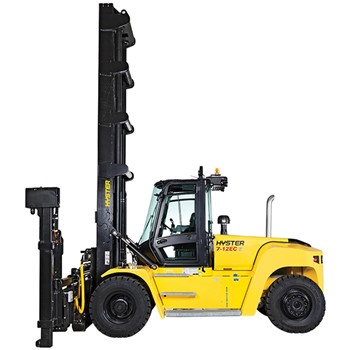
Hyster 7-12EC
Like reach stackers, mast container handlers have lift capacities that reach into the tens of thousands of pounds. Unlike reach stackers that can lift containers multiple stacks high and two or more container rows deep, mast container handlers are relegated to lifting containers only upward, although some models can stack containers eight stacks or higher. Elsewhere, some mast container models provide the ability to stack two containers at a time, often through the use of various attachments.
Mast Container Handler Features
Mast container handlers generally have diesel engines, some type of counterweight design or mechanism, reinforced frames and chassis, and designs that account for the mast to provide operators with enhanced or full visibility. Depending on the model and the application, features can variously include load- and weight-sensing technologies, touchscreen displays to control various functions and access diagnostics information, mast-tilting ability, various mounted cab positions, ergonomically designed cabs, reverse-warning alarms, strobe or warning lights, oil-cooled wet brakes, and multifunction joysticks and controllers. Newer models increasingly featuring mast designs that provide enhanced stability, as well as body designs that provide easier accessibility to the engine and components to make maintenance chores easier. Manufacturers are also putting more emphasis on safety-related features and fuel-related technologies that help reduce emissions and fuel consumption.
Find The Right Mast Container Handlers
While mast container handlers and reach stacker container handlers perform the same function, there are notable differences between the two machine types that experts agree leave them with advantages and disadvantages. While some experts argue that mast container handlers are less expensive, quicker, and more maneuverable, others argue they also provide less driver visibility than reach stackers, which locate the boom behind the cab. Elsewhere, some experts argue the mast container handlers are better-suited overall for consistently handling of empty containers, while others argue that reach stackers provide more overall flexibility and more physical stability longitudinally due to their design. Some leading manufacturers of mast container handlers include Fantuzzi, Hyster, Kalmar, Konecranes, and Taylor.

 Get Financing

